The Period-Film Authenticity Trap
Period-film authenticity is more than elaborate costumes and sets. Learn to separate a film’s persuasive atmosphere from historical claims that need evidence.
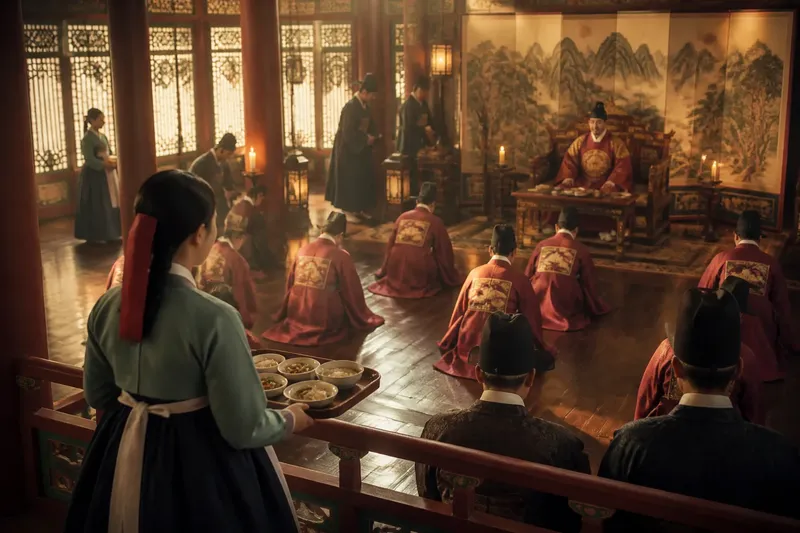
The most common mistake in judging period-film authenticity is treating a crowded frame as a documented one: antique furniture, aged fabric, and candlelit faces can look convincing while saying little about whether the details belong together. The cost is mistaking a persuasive style for evidence about the past.
That distinction is useful when watching Korean historical dramas such as Dae Jang Geum (also known as Jewel in the Palace), a television series set in the Joseon court. Its palace settings and court life offer a specific example of historical storytelling, but a scene’s visual coherence alone cannot establish that every costume, custom, or interaction reproduces Joseon-era practice.
Why is period-film authenticity hard to judge?
A film or television drama is not a museum room assembled for inspection. It selects, arranges, and lights details to tell a story. A robe can signal rank, a doorway can frame a moment of separation, and a painted landscape can connect a character to a tradition. Those choices may be expressive even when they are not literal reconstructions.
The trap appears when visual coherence is mistaken for historical proof. A production can make a whole world feel unified through one palette, repeated motifs, and consistent costume design. That unity may be an artistic achievement, but it does not establish that every object, gesture, or social custom was common in the period represented.
Historical accuracy also has different scales. A drama might present a broad political arrangement while compressing events, reproduce a surviving building while inventing private dialogue, or use a recognizable object in a new dramatic context. Rather than asking whether the entire work is “accurate,” notice the level of each claim: material, social, political, or emotional.
What can visual atmosphere tell you?
Atmosphere is the work’s sensory argument about the past. It emerges through color, texture, sound, blocking, and the space between people. In Dae Jang Geum, for example, palace interiors and formal court settings help make hierarchy legible to the viewer. That dramatic effect does not, by itself, show that a particular ceremony or exchange took place in precisely the way the scene presents it.
Look for patterns before treating a single detail as evidence. Do officials repeatedly occupy a higher level in the frame? Are domestic spaces shown as intimate, formal, or exposed? Does the production associate a fabric or color with a social role? Such repetitions reveal the work’s visual grammar: they show how it wants its world to be read, not necessarily how every historical community understood it.
Sound can make the distinction clearer. A score may evoke traditional instruments while the scene’s rhythm follows contemporary screen storytelling. A carefully composed soundscape can suggest a cultural past without functioning as an archival recording. Atmosphere is meaningful, but its meaning is not the same as documentation.
Which approach to authenticity fits your question?
There are three useful ways to watch: treat the work as a visual world, examine it as a set of historical claims, or compare its choices with sources outside the screen. Each answers a different question. Confusion often comes from asking one approach to do another’s work.
Is atmosphere enough for an expressive reading?
Yes, if your question is how the work makes a past feel coherent, mournful, threatening, or elegant. Track recurring colors, spatial arrangements, costume contrasts, and sounds, then connect those patterns to character and theme. This approach suits viewers interested in screen language, including works that stylize rather than reconstruct.
How do I assess a specific historical claim?
Isolate the claim before judging it: a title, office, ritual, object, or relationship between social groups. Ask what kind of evidence could support that detail, such as a contemporary image, a written record, or an object with a known context. This approach helps distinguish a plausible scene from a documented one.
When should I compare the work with outside sources?
Compare sources when a detail matters to your interpretation or when the work presents a strong claim as ordinary fact. A museum catalog, scholarly book, or reputable cultural institution can provide context, though sources may disagree or preserve only part of a story. Treat accuracy as a question of evidence, not a verdict based on appearance.
Can a deliberate invention still be historically meaningful?
Yes. A filmmaker may combine eras, alter a custom, or invent a private encounter to express a later community’s memory of the past. The useful distinction is whether the invention is being read as documented fact, dramatic interpretation, or symbolic design.
How can you separate evidence from design?
Begin with the scene rather than a general judgment of the work. Name the detail that caught your attention, then identify what the scene asks you to infer. An ornate headdress might indicate rank, a ceremonial occasion, or simply the production’s idea of grandeur. Those are different claims, and each calls for different support.
Next, separate what is visible from what is implied. You may see a character kneel before a ruler; you may infer that the gesture reflects standard court protocol. The first is a fact about the scene. The second is a claim about history. You can accept the scene’s emotional force while keeping that inference open.
Then match the question to a source. A surviving garment can help with cut and construction, but may not establish how often it was worn or by whom. A written account can describe a ceremony, but may reflect the writer’s position or purpose. A painting can preserve visual conventions while simplifying ordinary life. Sources are most useful when matched to the claim they can address.
Imagine an invented period drama showing a merchant’s household eating from blue-glazed bowls, with the camera treating them as a sign of everyday comfort. You note the inference, then consult a museum catalog describing comparable ceramics and their known contexts. If the catalog supports the vessel type but not its routine use in that household, the scene remains visually plausible while its social meaning stays uncertain. That is more precise than calling the whole work either authentic or false.
What does each approach miss?
Atmosphere-first viewing can mistake a persuasive design system for a record of lived experience. It is useful for interpreting form, not for settling who used an object or how a custom worked.
Claim-by-claim scrutiny can become narrow if it treats every artistic choice as a fact-checking problem. A work may intentionally compress events or use symbolic costume. Checking a detail is worthwhile when it affects your reading; tracing every background object is usually not. The effort is not worth it when the detail has no bearing on the work’s argument.
Source comparison can also produce false certainty when one surviving object or text is made to stand for an entire society. What remains is not necessarily representative of what was common, and a source may be shaped by its maker, owner, or preservation history. Let sources refine your judgment without erasing their limits.
How should you choose your viewing approach?
Choose according to the question you want the work to answer. If you are studying its visual style, start with atmosphere and look for repeated choices. If you are considering a claim about a historical custom, isolate it and seek a source suited to that claim. If an invention is central to the work’s emotional or political meaning, keep both readings in view: what the scene does as cinema and what it can support as history.
For a classroom discussion, film club, or private viewing, a simple note can keep the distinction clear: “The scene shows…” followed by “I infer…” and, where needed, “A source would need to establish….” This is not a scoring system. It is a way to keep a vivid image from quietly becoming evidence in your mind.
Period-film authenticity is more useful as a question than as a label. A screen’s surfaces may carry researched details, inherited conventions, and present-day imagination at once. When considering period-film authenticity, notice what the image makes you feel, then ask what it gives you grounds to believe; the space between those responses is where historical viewing becomes more precise.