The Long Take and the Changing Sense of Time
The long take changes how film time feels by shifting attention from cuts to movement, duration, and the details a viewer chooses to follow.
The most common mistake in watching a long take is to treat its unbroken length as the point. That can make a scene feel like a feat to admire rather than an event to read, and it can obscure what the shot is doing with attention. A long take changes a viewer’s sense of time by making duration, movement, and choice more visible.
What does a long take ask you to watch?
A long take is a shot that continues for an extended stretch without an edit. There is no universal duration that makes it “long”; the effect depends partly on the pace of the scene around it. A sustained shot after a run of quick cuts can feel expansive, while a similar stretch in a patient film may seem ordinary.
With no cut to redirect the eye, the frame becomes a small field of possibilities. A character crosses a room, a doorway stays open behind them, or another person enters the background. The camera may guide attention with a pan or a tracking movement, but it does not necessarily settle on one detail. The viewer must decide what to follow.
This is not the same as a shot with nothing happening. A still camera can hold a room while someone’s posture shifts, a conversation falters, or activity continues at the edge of the frame. The apparent quiet may make small changes more legible. In a moving shot, the camera’s route can shape what is noticed and what remains out of view.
Why can the same stretch of screen time feel different?
Clock time and felt time do not have to match. A continuous shot may seem brief when a character moves toward a clear goal, because the viewer’s attention is occupied by the approach. A shorter passage may feel prolonged when the action stalls and the frame offers no new direction to follow.
Expectation matters. If a character is approaching a door, the viewer may begin waiting for it to open before anything happens. If the character instead circles the room, the shot may feel less like a countdown and more like a search. The camera can intensify either experience by staying close, holding back, or changing position at the moment attention begins to settle.
Sound also shapes duration. A repeated footfall, a motor heard from offscreen, or a pause in conversation can make time feel measured even when the image keeps changing. Conversely, layered activity can make a sustained shot feel full rather than slow. It helps to listen for what continues after the apparent center of the scene moves elsewhere.
How does the camera make movement feel?
Movement is not only a matter of speed. A camera that follows one person can make a crowded place feel like a path through competing distractions. A camera that lingers as the person leaves may turn the empty space into the event. In either case, the shot’s route changes the viewer’s relation to the scene: close enough to share a character’s pace, or distant enough to notice what they overlook.
Think about thresholds. A camera can follow someone through a doorway, stop at the entrance, or remain in the room as the figure disappears. These choices set different limits on access. Passing through with the character can make the next space feel like a discovery; staying behind may preserve the tension of not knowing what comes next.
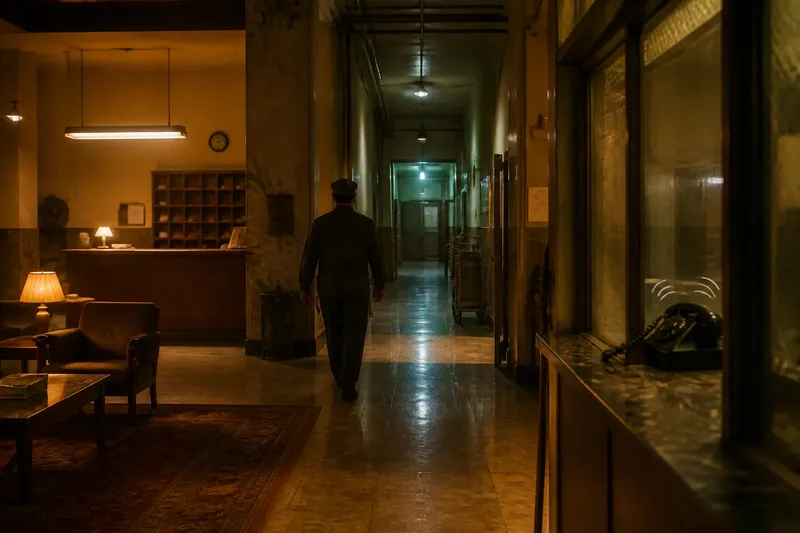
Imagine a fictional scene in which a night-shift attendant walks from a lobby to a service corridor while a phone rings out of sight. If the camera trails close behind, the unanswered call may feel like a pressure accompanying the attendant. If it stays in the lobby, the attendant’s departure can make the ringing room seem to take over the scene. The starting situation is the same, but the shot’s position shifts what the viewer waits for.
Does a long take always create realism?
No. An unbroken image can feel immediate, but that feeling is not proof of unfiltered reality. The shot still has a frame, a camera position, a duration, and a chosen path through the space. Blocking, performance, focus, and sound all help organize what seems to unfold naturally.
Nor does continuity automatically make a scene more truthful than editing. A cut can reveal a relationship between separate moments; a long take can conceal an action outside the frame or delay access to an important detail. The more useful question is not whether the shot is “real,” but what its uninterrupted form asks the viewer to experience: proximity, uncertainty, patience, or a wider awareness of simultaneous activity.
Some long takes are conspicuously choreographed, with actors and camera moving through carefully timed paths. Others keep their movement modest and let the duration do more of the work. Neither approach has a fixed meaning. A highly composed shot may expose the labor of staging, while a restrained one may draw attention to gestures that a more active camera would overrule.
What should you notice during a long take?
Where does your attention go when the frame does not cut?
Track the main action, then glance toward the frame’s edges and background. If another detail draws you away, ask whether the camera encourages that shift or leaves you to make it.
Does the camera follow, lead, or wait?
Following can align the viewer with a character’s pace; leading can make the character seem to enter a space already claimed by the camera. Waiting may leave the viewer with an empty room, a delayed entrance, or an action that has moved out of view.
What changes before the shot ends?
Look beyond plot information to changes in distance, posture, sound, and who occupies the frame. A scene can alter its emotional balance without introducing a new event.
When does the shot begin to feel long?
Notice the moment when you start anticipating a cut, a movement, or a reply. That expectation is part of the experience: the film has made you aware of your own waiting.
What is not worth the effort?
There is little value in timing every sustained shot with a stopwatch or debating whether it crosses a fixed threshold. Such bookkeeping can be useful for a specific formal comparison, but it rarely explains why a shot feels tense, roomy, or restless. Attend instead to what the uninterrupted duration lets you notice that a cut might have removed.
It is also easy to assume that a long take is automatically more demanding or more accomplished. Length alone says little about how well a shot serves its scene. A brief, controlled hold may change the viewer’s sense of time more sharply than a longer passage whose attention and movement remain unchanged.
How can you describe the effect precisely?
When discussing a long take, name an observable choice and its effect rather than relying on a broad verdict. “The camera stays behind as the character exits, leaving the ringing phone in the foreground” gives another viewer something to look for. “The shot feels immersive” may describe a response, but it does not explain how the film shaped it.
A useful note can be as compact as this: the camera follows, the character stops, background activity continues, and the viewer begins watching the room rather than the character. That description links movement to attention and duration without claiming that every viewer must feel the same thing.
The long take, then, is less a single style than a way of arranging time inside the frame. In the next sustained shot, notice not only how long it lasts, but what you are waiting for, where the camera lets you look, and what remains when the action moves on. Those details make the changing sense of time easier to see.