Film Clubs and Shared Viewing Before the Multiplex
Film clubs made cinema a shared occasion: learn how local groups used borrowed rooms, membership, discussion, and programming to shape film culture.
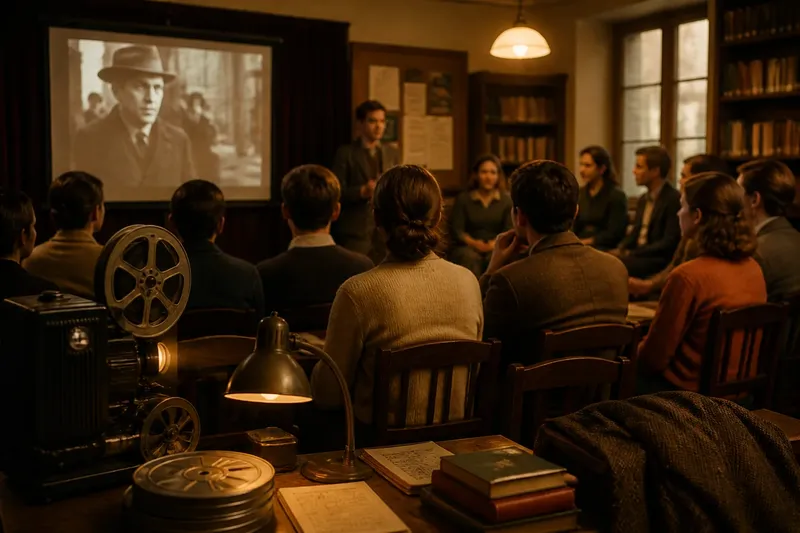
The common mistake is to treat film clubs as miniature cinemas run by enthusiasts. That misses their distinct purpose: they organized recurring gatherings around films, often adding introductions, discussion, or member-led programming to the screening itself. In Britain and the United States, especially from the 1920s through the postwar decades, clubs formed one part of a wider, varied culture of organized film societies; they were not a universal substitute for commercial theaters.
Film clubs before the multiplex worked through local arrangements rather than a single national model. Some met in schools, universities, libraries, or community halls; others operated in connection with educational or cultural organizations. Their reach and programming depended on local organizers, available venues, and access to films. The important distinction was not simply the size of the screen, but the way a group made viewing a continuing social occasion.
How did film clubs make audiences part of the occasion?
At a commercial screening, people could arrive as strangers, watch, and leave without exchanging a word. A club gave attendance a social frame. Members might recognize one another, welcome newcomers, and see a familiar group take shape from one meeting to the next.
That familiarity changed the meaning of showing up. A person was not only attending a screening; they were joining an organized gathering. The distinction mattered in places where cinema-going was not already a routine shared by neighbors. A club supplied a reason to go out and a group with whom to do it.
The arrangement did not require every member to become a close friend. Even modest rituals—finding a seat near someone familiar, exchanging greetings, waiting together before the lights went down—gave a screening a local character. The audience was visible to itself.
Why did clubs use borrowed rooms?
Some film clubs relied on spaces with other purposes: school halls, community rooms, libraries, university buildings, or workers’ institutes. A screen and projector could temporarily change a room’s use without requiring the group to operate a permanent theater.
These venues connected screenings to institutions and associations already present in local life. A university club might draw students and staff; a neighborhood group could meet in a hall familiar from other events. This pattern varied by place and organization, so borrowed rooms should be understood as one practical option, not a defining feature of every club.
Say a small-town club has permission to meet in a library room after closing. Its organizers arrange chairs, set up a screen, and invite the audience to stay for conversation. The expected result is a recurring gathering in a familiar space, not a new cinema building.
Reproducing the grandeur of a commercial theater in a borrowed room is not worth the effort. The club’s purpose was to make a workable gathering, not to disguise the room’s ordinary character.
How did membership shape a club’s audience?
Membership could give screenings continuity beyond a single public showing. Members might receive notices, help choose programs, volunteer at the door, or bring a guest. Those responsibilities made the event feel partly theirs.
Membership did not make a club automatically inclusive. A newcomer might feel uncertain among people who already knew one another; a clear welcome and an open invitation to discussion could help. The social character depended on decisions about invitations, fees, introductions, and participation.
A club was therefore not simply an audience assembled by a film. It was a group that made choices around watching. Members could return even when a particular program did not match their tastes because the ongoing company was part of the attraction.
What happened after the screening?
Conversation let viewers compare responses while the experience was fresh. Someone might mention a scene that unsettled them; another could disagree about its meaning. The point was not to settle on one approved interpretation, but to make private reactions audible to others.
Organizers had to decide how much structure to provide. A short introduction or a chairperson’s question could help conversation begin, while a long lecture might leave little room for members. A useful balance made space for context and for responses from viewers with different levels of confidence or knowledge.
How did programming reflect local priorities?
When members or committees selected films, their choices reflected local interests and practical limits. A program might bring attention to work not readily available in ordinary local exhibition, though what a club could show depended on access, permissions, and organizational resources.
Selection was a form of stewardship: someone had to seek access, arrange a screening, and invite an audience. This did not make every club adventurous or representative. A small committee could favor its own tastes, and the calendar could leave some interests out. Still, choosing films gave members a role beyond attending a schedule set elsewhere.
What do readers ask about film clubs before the multiplex?
How did a film club differ from a commercial cinema?
A film club organized a recurring group around screenings, while a commercial cinema primarily offered public showings on its own schedule. Clubs might add membership, discussion, or member involvement in programming.
Did every film club hold discussions?
No. Some made conversation an explicit part of the meeting; others focused on the screening and informal socializing. The format depended on the organizers, venue, and members.
Were film clubs found only in Britain and the United States?
No. Organized film societies and clubs appeared in different national settings, with distinct histories and institutional arrangements. The examples here focus on Britain and the United States rather than claiming one model applied everywhere.
Why are film clubs part of screen history?
They show how cinema could be organized as a recurring social encounter, not only as a visit to a commercial theater. Their histories also draw attention to local hosting, discussion, and decisions about what audiences could see together.
Which small acts of hosting shaped the gathering?
Announcing a meeting, preparing a room, greeting people at the door, and explaining the evening’s format could shape whether newcomers felt welcome. These tasks also helped establish whether conversation would be shared or dominated by a few regulars.
A knowledgeable speaker could offer context without making specialist knowledge a condition of participation. A viewer could contribute by describing a response and listening to how others answered it. That balance made the audience’s presence something organizers could consciously shape.
To understand film clubs before the multiplex, look beyond the projector to the room people entered and the conversation they carried away. The useful historical point is a limited but significant one: in particular local settings, clubs made shared viewing a recurring social practice, and the details of that practice varied with the people and institutions that sustained it.